Pari is a beautiful and small fraction of the scattered municipality of Civitella Paganico, in the province of Grosseto in the heart of the Tuscan Maremma. A splendid village with typical medieval characteristics, Pari has a thousand-year history, starting with the ancient Etruscans, the first to colonize these lands, passing through the Romans, up to the times when the Counts of Ardenghesca ruled, who chose it as a private residence, before the town, like the other hamlets, became part of the orbit of Siena. Pari is also famous for being the birthplace of the great twentieth century writer Federigo Tozzi. Inside his books we read about Pari and the small village of Ferraiola, at the foot of the town. Even today Pari is the seat of a fervent intellectual activity.
What to see in Pari
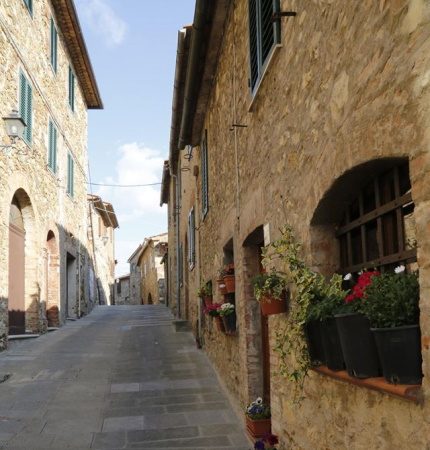
Pari is a village that has perfectly preserved its beautiful medieval structure over the centuries. Pari, like other neighboring towns, was a small settlement dating back to the Archaic Upper Palaeolithic. Today this splendid village in the Tuscan Maremma preserves many palaces, monuments and churches within its beautiful walls that perfectly tell its extraordinary personal history.
- Walls of Pari
- Church of San Biagio
- Oratory of Santa Croce
Walls of Pari
The Walls of Pari are the ancient defensive system of the homonymous hamlet of Civitella Paganico. A beautiful structure with a defensive and military purpose built in the mid-twelfth century to protect the historic center of this village, which occupied a strategic position of control over the Ombrone valley. The walls of Pari were built by the will of the Ardengheschi, who controlled the town of Pari from its origins until the mid-200s. This beautiful architectural element has been well preserved over the centuries and are still visible today by visiting the small Maremma village of Pari. Part of the walls, today is incorporated into the houses, which over the centuries have been built close to the fortification. Among the most interesting aspects to see are the beautiful and ancient gateways to the village: Porta Grossetana, an arched opening located in the southwest area of the walls and Porta Senese located to the east. These two ancient gates still retain important traces of the epic past history of this village. Along Porta Grossetana you will also be able to admire a valuable jamb, a typical medieval architectural element, on which the arch that allows access to the ancient part of Pari rests.
Church of San Biagio
The Church of San Biagio is one of the most important places of worship in the hamlet of Pari in the scattered municipality of Civitella Paganico. A majestic stone building of medieval origin, the date of construction of which is not known. What we know for sure, however, is that the Church was restored for the first time in 1466 by Pope Pius II, while the front of this sacred building was also remodeled in 1850. Next to the church dedicated to San Biagio, a beautiful 17th-century bell tower stands proudly, while inside the building you will find stylistic elements typical of the Middle Ages and some works of valuable value. The church, in fact, still presents itself today with an interior with a single large central nave, which makes the environment solemn and majestic. Here, moreover, typically eighteenth-century paintings are magnificently preserved including “Madonna with Child and Saints” and “Madonna with Child and Saints Peter and John the Baptist”, the result of the skill of the school of Domenico Beccafumi, one of the fathers of the Italian mannerist current and one of the last artists of great influence of the Sienese school.
Oratory of Santa Croce
The Oratory of Santa Croce, is another monumental building symbol of the ancient history of the village of Pari. The building stands right next to the Church of San Biagio, and is dedicated to the holy figures of Fabiano and Sebastiano. The Oratory has been partially recovered after years of neglect. Here there is a fifteenth-century painting of great value, placed on the central wall of the sacred building, in which the Madonna and Child are depicted between the saints Fabiano and Sebastiano. The work was created by Marco Bigio, a painter of the mid-sixteenth century who was a pupil of Sodoma.
Where to sleep in Pari
Pari, despite being a small village scattered on the top of a hill in the middle of the wild nature of the Maremma countryside, has a good number of accommodation facilities, in which to stay, for a holiday to discover the wonders hidden in the Maremma lands. Beautiful farmhouses surrounded by greenery, small family-run hotels, but also B & Bs and apartments, many and different types of structures able to satisfy the interests and needs of all those who reach this fabulous location.
Where to eat in Pari
In Pari as well as in the whole municipality of Civitella Paganico, tradition is the great protagonist of the dishes you will taste in this locality.
Da Sandra e Barbara (Piazza Castelfidardo 1, Pari) Score 4,0
Small family-run restaurant with typical Maremma cuisine, a rustic and intimate place in which to rediscover the classic Tuscan flavors, in a serene and relaxed environment. The restaurant is open for both lunch and dinner. For more information or reservations +39 339 815 5804
Il Cacciatore (Piazza della Chiesa, Pari) Score 4,00
Small restaurant with typical local cuisine, a convivial place, in which to taste excellent and abundant dishes of the Tuscan food and wine tradition. Il Cacciatore focuses on the simplicity and genuineness of its products which, combined with the home environment, make this restaurant one of the landmarks of Pari. For more information or reservations +39 0564 908887
History of Pari
Pari has a history that is lost in the mists of time. The town stands on the top of a hill, from which interesting historical finds have come to light that suggest that a village dating back to the Upper Paleolithic period was built here. Subsequently the territory of Pari was widely frequented by both the Etruscans and the Romans. The current center of this village in the Grosseto area is of medieval origin, with an urban layout characterized by narrow, circular streets. It was a very important possession of the noble Ardengheschi family, who dominated the whole town of Civitella Paganico, and then passed under the control of Siena in the thirteenth century. In the 16th century, Pari became part of the Grand Duchy of Tuscany whose fate followed.